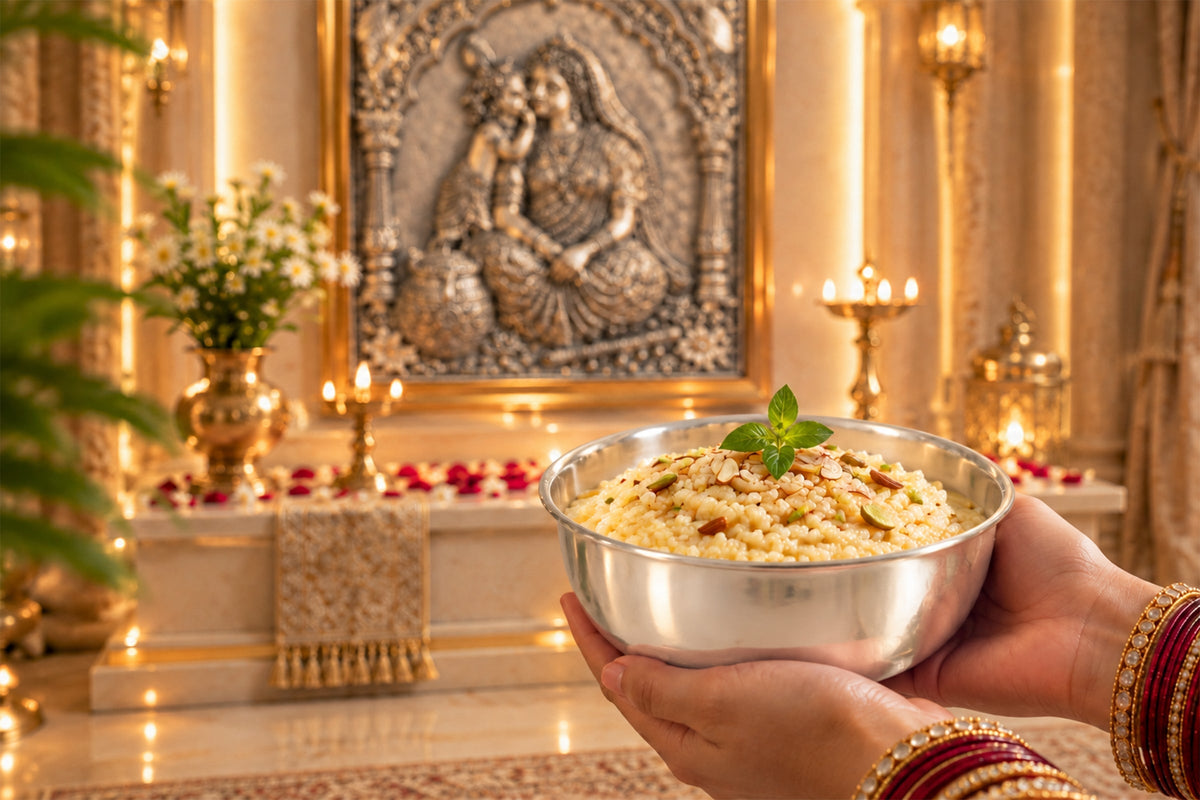

Article: FROM SILVER TO SEVA
FROM SILVER TO SEVA
How Silver Found Its Place in India’s Devotional Traditions
There is a quiet beauty in a silver vessel used for Seva.
It may hold water. It may carry an offering. It may become part of Aarti, Bhog or a daily ritual performed almost without thought.
But have you ever wondered why silver?
When did silver begin appearing in sacred spaces? Was it always considered a material for worship? And how did an everyday precious metal gradually become part of the objects used in devotional traditions?
The answer is not a single date, or a single tradition.
It is a story that unfolds over centuries — through craftsmanship, temple traditions, offerings, and eventually the intimate practices of Seva.
BEFORE SILVER, THERE WAS THE ACT OF OFFERING
The story really begins not with silver, but with Seva itself.
Across Indian devotional traditions, worship has never been only about prayer or words. It has also involved acts of offering and care — presenting water, food, flowers, light, fragrance and other things with reverence.
The vessel, lamp or utensil is the means through which that care is expressed.
This distinction is important.
The material does not create the devotion.
The devotion gives meaning to the act.
This idea becomes particularly important when we look at Pushtimarg.
Within Pushtimarg, Seva is described not merely as ritual action, but as an expression of love toward the sevya swaroop. The tradition does not prescribe that devotion becomes meaningful because an offering is made from an expensive material. Rather, the material things used in Seva are understood as outward expressions of the devotee's love.
So silver did not create Seva.
Silver became one of the ways Seva could be expressed.
WHEN DID SILVER ENTER THIS WORLD?
This is where history becomes fascinating — and where it is important not to invent a simple answer.
There is no reliable historical evidence that allows us to say:
“Silver became part of Seva in the year ____.”
Its use developed gradually, and surviving evidence comes from different regions and different traditions.
Silver was already being worked into vessels in the ancient world. Museums preserve examples of sophisticated silver vessels dating back thousands of years, showing that silver had long been valued as a material for objects of importance and refinement.
But evidence specifically connecting silver with Indian devotional practice appears through particular historical records.
One remarkable example comes from the Brihadishvara Temple at Thanjavur.
An inscription associated with the temple records silver utensils presented by the Chola king Rajaraja. The list includes bowls, censers, small baskets and other vessels, and even mentions images made of silver.
This gives us something much more valuable than a vague claim that “silver has always been used in temples.”
It gives us evidence.
Silver vessels were being dedicated to an Indian temple more than a thousand years ago.
SILVER WAS NOT JUST FOR BEAUTY
Why would a precious metal be used for vessels and objects connected with worship?
Part of the answer lies in the nature of silver itself.
It is:
Malleable enough to be shaped into detailed objects.
Durable enough to be kept and passed down.
Valuable enough to represent a meaningful offering.
Reflective enough to interact beautifully with light.
But perhaps most importantly, precious materials allowed an ordinary functional object to become something worthy of being offered.
A bowl can hold water.
A silver bowl can also represent the care with which that water is offered.
A lamp can hold a flame.
A carefully crafted silver lamp can turn that everyday act into an object worthy of preservation.
This is one of the reasons silver appears so naturally in the history of ceremonial and devotional objects.
FROM TEMPLE OBJECTS TO DEVOTIONAL PRACTICE
Over time, silver became part of many forms of ceremonial material culture.
Its use was not limited to one object or one ritual.
Historical evidence records silver vessels, ceremonial objects and images. In South Indian temple traditions, for example, silver vessels have been used in connection with Abhishekam and other sacred practices. The Tirumala Tirupati Devasthanams records silver vessels being used to carry water, sandalwood, saffron and other substances for Abhishekam.
Tirumala also preserves a particularly striking example from 966 CE: the silver Bhoga Srinivasa Murthy associated with Queen Samavai's donation. TTD describes the silver deity as a representation of the principal deity and continues to commemorate that historic silver image today.
These examples tell us something important.
Silver was not simply placed in a sacred space because it looked beautiful.
It could become part of the actual service surrounding the deity.
THEN COMES SEVA AT HOME
The story becomes even more intimate within traditions where the deity is cared for almost as a member of the household.
This is particularly meaningful in Pushtimarg.
Pushtimarg developed a distinctive understanding of Krishna Seva in which the devotee's relationship with the swarup is personal and deeply rooted in bhav.
The tradition describes Seva through everyday acts of care — waking, bathing, dressing, offering food, adorning, offering water, performing Aarti and preparing the space in which the deity resides.
And once Seva becomes part of everyday life, the objects used for it become important too.
Not because the object itself is divine.
But because something used repeatedly in an act of love becomes part of that relationship.
THE JHARI — A BEAUTIFUL EXAMPLE
Consider the Jhariji.
In Pushtimarg Seva, the Jhariji is used for offering water to the Nidhi Swaroop. Traditional descriptions note that Jharis and related vessels can be made from different materials, including earthenware, copper, silver and gold.
That fact reveals something profound.
Silver is not compulsory for Seva.
The same devotional purpose can exist with different materials.
What changes is not the love behind the Seva, but the form through which that love is expressed.
The Jhariji therefore becomes more than a vessel.
It becomes part of the rhythm of Seva.
Water is offered.
The vessel is cleaned.
It is prepared again.
It returns to its place.
And the cycle continues.
The material becomes part of the tradition through use.
FROM JHARI TO AARTI, BHOG AND DAILY SEVA
Once we look closely, we begin to understand how many familiar silver objects can find their place in devotional life.
Jhari
For offering water.
Kalash and other vessels
For holding and presenting water and other offerings.
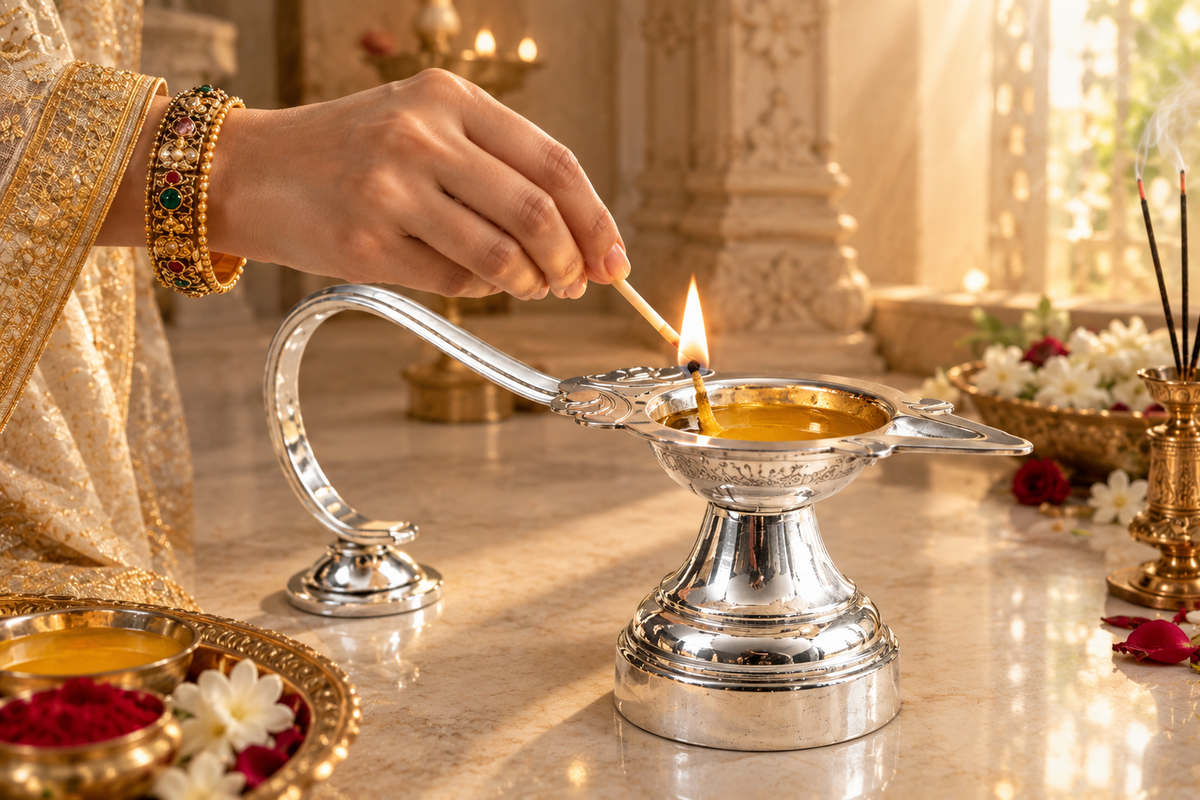
Diya
For carrying the flame used in Aarti.
Panch Aarti
For the ritual offering of light.
Bell
As part of the devotional environment.
Bhog vessels
For presenting food.
The exact objects, materials and practices can vary between traditions, temples and households.
And that variation is important.
There is no single universal “silver Seva set.”
Seva is shaped by tradition, lineage, place, season, household and bhav.
THE BEAUTIFUL PARADOX OF SILVER
This brings us to something that is easy to miss.
Silver is precious.
But Seva is not valuable because the object is expensive.
In fact, Pushtimarg sources make the distinction very clearly: the Lord seeks the devotee's love, while material offerings are outward expressions of that love. The tradition also emphasizes that there is no fixed quantity of material required for Seva.
So the true story of silver and Seva is not:
“Silver is sacred, therefore use silver.”
It is closer to:
“What we offer becomes a reflection of how we care.”
A simple flower can be offered with devotion.
So can water.
So can food.
And so can a carefully crafted silver vessel that a family chooses to use every day.
WHY SILVER STILL MATTERS TODAY
Perhaps this is why silver continues to feel so natural in devotional homes.
It sits between utility and meaning.
A silver diya is still a diya.
A silver bowl is still a bowl.
A silver Kalash still holds what it was made to hold.
But when an object is carefully made, used repeatedly and associated with moments of devotion, it begins to accumulate something that cannot be measured by its weight.
Memory.
The diya used during a child's first festival.
The vessel used every morning.
The Aarti brought out on special occasions.
The silver piece received as a gift and eventually passed to another generation.
This is where an object becomes more than an object.
It becomes part of a family's story.
FROM GENERATION TO GENERATION
Perhaps the most beautiful thing about silver is not that it shines.
It is that it can stay.
Traditions change around us. Homes change. Generations change.
But an object made with care can remain.
A grandmother may have used it.
Her daughter may continue the same Seva.
One day, her child may hold the same piece.
The silver remains — quietly carrying a memory from one generation to another.
And this is where the idea of an heirloom begins.
Not simply something expensive.
Something meaningful enough to keep.
SO, WHEN DID SILVER BECOME PART OF SEVA?
The honest answer is:
There was no single beginning.
Silver had already been valued and crafted into important vessels long before many of the devotional practices we recognize today took their present forms. Historical temple records provide evidence of silver vessels and images in Indian sacred contexts, while later devotional traditions show silver becoming integrated into specific forms of Seva.
What developed over time was a relationship between:
Material → Craft → Offering → Practice → Memory
And eventually:
Silver became part of the language through which devotion could be expressed.
WHAT SILVER MEANS TO US
At MD Silver, this history is what makes silver interesting to us.
Not simply as a precious metal.
Not simply because it is beautiful.
But because of what it can become when it enters someone's life.
A diya can become part of an evening Aarti.
A vessel can become part of daily Seva.
A Kalash can become part of a festival.
A carefully crafted piece can become part of a family's tradition.
And years later, that same piece may still be there.
Still silver.
Still beautiful.
But now carrying something that silver itself could never manufacture:
memory, devotion and love.
**Because silver is the material.
Seva is the act.
And Bhav is what gives it meaning.**